Unlock Team Potential With a Coaching Approach
- Jan 8
- 5 min read

Imagine a leader who makes hundreds of decisions every day but feels that the team isn't reaching its potential.
Many managers face the paradox of modern business. They possess all the technical skills, know the market and product, but the team isn't working at full capacity. Employees perform tasks formally, initiative fades, and results remain mediocre. Sound familiar?
The root of the problem often lies not in strategies or processes, but in the leader's ability to unlock people's potential. This is where coaching in management becomes not just a trendy fad, but a necessary tool for creating a truly effective team.
Business coaching is not a set of ready-made solutions that can be applied to any situation. It's a way of thinking and interacting that helps leaders create conditions where each employee can demonstrate their best qualities and achieve results that seemed unattainable.

Coaching Approach as the Foundation of Effective Leadership
Traditional management is built on the principle of "I know what's best, so do it this way." Strategic coaching offers a different interaction model, where the leader becomes a facilitator of their team's growth.
When you apply coaching technologies in business, you don't provide ready answers, but help the employee find the solution independently. This fundamentally changes the quality of task execution. A person who arrived at the solution themselves will implement it with much greater engagement and responsibility.
Developing leadership skills through coaching begins with changing the leader's internal position. Instead of being a controller who monitors task completion, you become a partner who helps unlock the potential of each team member.
Effective leadership in a coaching style requires you to be able to ask the right questions. Instead of "Why didn't you do this earlier?" it's better to ask "What would help you complete this task more effectively?" This approach creates an atmosphere of trust and opens space for creative solutions.
Practical Tools for Implementing Coaching in Management
The GROW model (Goal, Reality, Options, Will) is one of the most effective strategic coaching tools that easily adapts to team management. When an employee comes with a problem, you sequentially explore together with them the goal, current reality, possible solution options, and concrete action steps.
Goal setting in coaching differs from traditional planning. You don't simply set a task, but help the person formulate the goal themselves so that it's personally meaningful to them. This creates internal motivation, which is much stronger than external coercion.
Coaching for entrepreneurs includes working not only with the team, but also with one's own limitations. Often leaders cannot delegate tasks because they fear losing control. The coaching approach helps recognize these fears and find ways to overcome them.
Change management through coaching becomes a more organic process. Instead of imposing new rules, you create conditions where the team itself comes to understand the necessity of changes and actively participates in their implementation.
Transforming Corporate Culture Through Coaching Principles
Corporate culture is formed not by declarations on office walls, but by daily interactions between people. When leaders apply coaching in the organization, they create a culture where openness, honesty, and the drive for development are valued.
Employee motivation in a coaching culture happens not through external incentives, but through creating conditions for self-realization. People begin working not because "it's necessary," but because they see meaning in what they do and feel support in their professional growth.
Coaching in personnel management helps create an atmosphere of psychological safety. Employees aren't afraid to share their ideas, admit mistakes, and ask for help. This significantly increases the efficiency of the entire team's work.
Developing corporate values through coaching principles happens naturally. When leaders demonstrate respect for each person, support the drive for development, and create conditions for honest dialogue, these values automatically become part of the corporate culture.
Long-term Development Strategy Through Coaching
Coaching in business strategy is not a short-term tactic for solving current problems, but a long-term approach to organizational development. When you invest in developing coaching skills, you create a sustainable foundation for company growth.
Training leaders in coaching becomes a strategic advantage for the organization. Every manager who possesses coaching skills is capable of not only effectively managing their team, but also developing each employee's potential.
Coaching for top managers is especially important since they set the tone for the entire organization. When senior leadership demonstrates a coaching approach, this influence spreads to all levels of the company.
Professional growth through coaching creates a multiplication effect. One leader who has mastered coaching skills can transform an entire department's work, which ultimately positively impacts the results of the entire company.
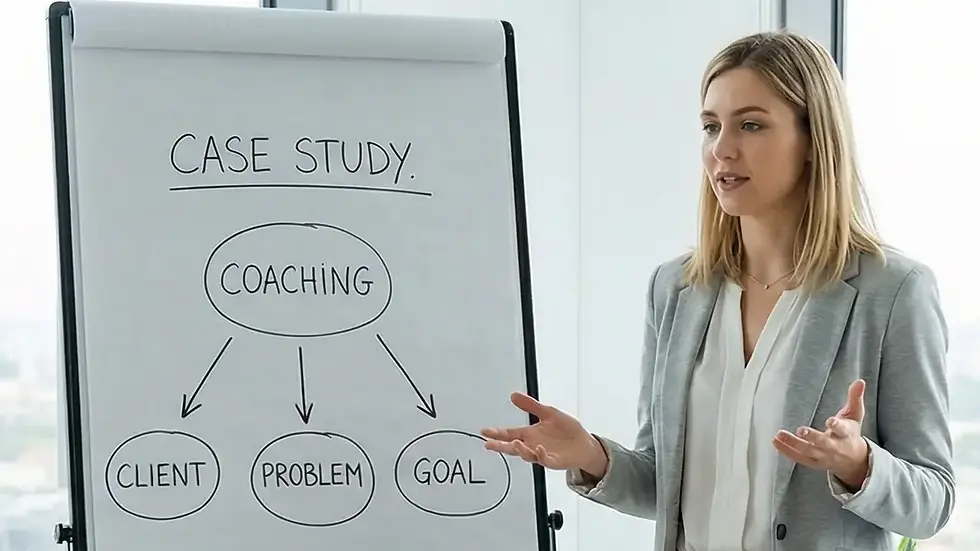
Coaching in business management is not simply a set of techniques that can be quickly mastered and applied. It's a deep transformation of the approach to managing people, which requires time, practice, and constant development.
Many leaders understand the value of coaching skills but don't know where to start. It's important to realize that coaching is not a service that can be purchased, but a skill that needs to be developed within oneself. This is precisely why it's so important to receive quality education in the field of coaching.
At COACHING UP, we understand that every leader is unique, and the approach to mastering coaching skills should be individual. Our professional coach training program is the only one in the world with triple accreditation from ICF (International Coaching Federation), AC (Association for Coaching), and EMCC (European Mentoring and Coaching Council), which guarantees the highest standard of education.
In just 6 months of training, you will not only master coaching tools but also undergo deep personal transformation. You will learn not only to apply coaching in management but also to live in accordance with coaching principles.
The path of developing coaching skills is a path to yourself. As the experience of our graduates shows, coaching becomes a path of mindfulness that transforms not only professional activity but entire life.
Many participants in our programs note that coaching becomes a journey to oneself, where they gain new clarity regarding their goals and ways to achieve them. This is especially important for leaders who must not only manage others but also constantly develop themselves.
In our community, everyone creates their own story of professional and personal growth. We see how our graduates achieve professional maturity and become true leaders in their fields.
The path of maturity in coaching is not only mastering techniques but also developing inner wisdom that allows effective work with people in any situation.
Begin your transformation journey today. Coaching in business management is not a dream about the future, but a reality you can create right now. Join our community of professionals who are already transforming their approach to management and achieving outstanding results.
Share this article with colleagues who also strive to develop effective management. Tell us in the comments what team management challenges are relevant for you. Together we can create a business environment where every person unlocks their potential and achieves outstanding results.